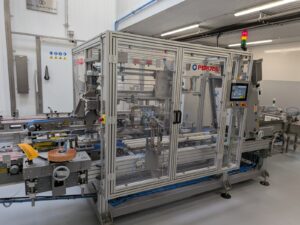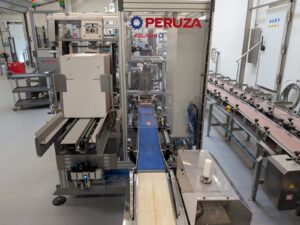
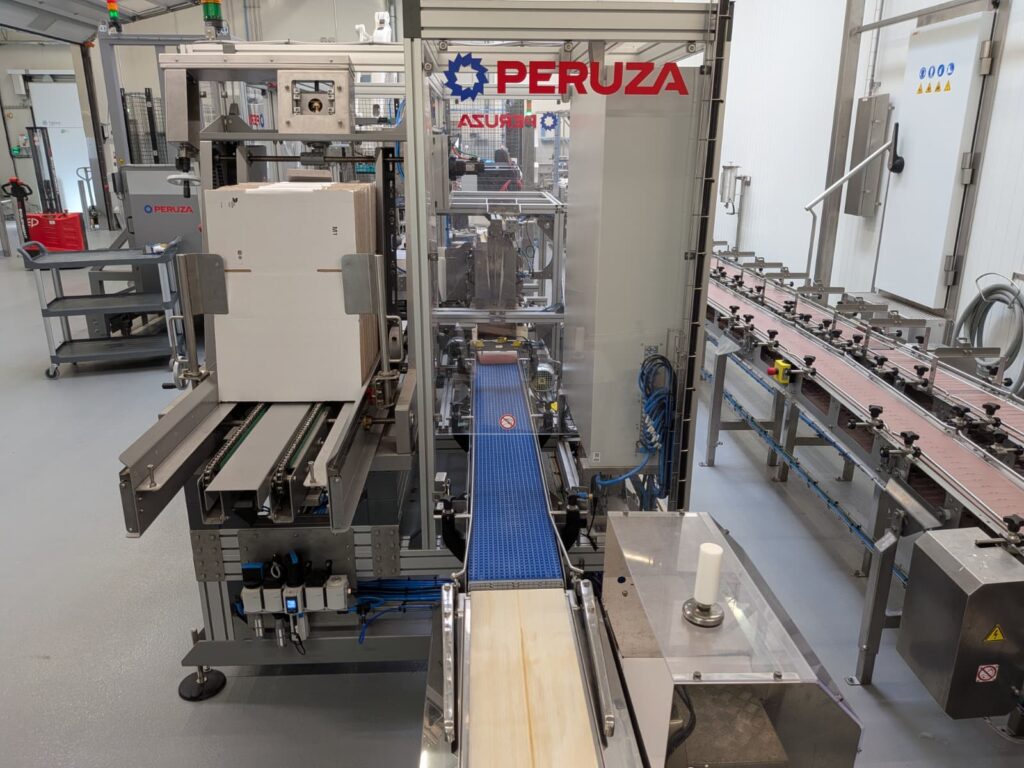
A side loader is a case packer that collates a group of products and pushes it horizontally into an open-ended case, instead of dropping or lowering it in from above. Because the product stays upright and supported the whole time, side loading is the usual choice for glass jars, narrow-neck bottles, aerosol cans and packs with delicate lids.
- Best for: fragile, unstable or top-sensitive containers, and products that must stand upright for shelf presentation.
- Main benefit: controlled, servo-driven motion with no free fall, which reduces breakage, label scuffing and seal damage.
- Main trade-off: side loaders are usually slower than high-speed top-load or drop packers, so they suit lines where product care matters more than peak case rate.
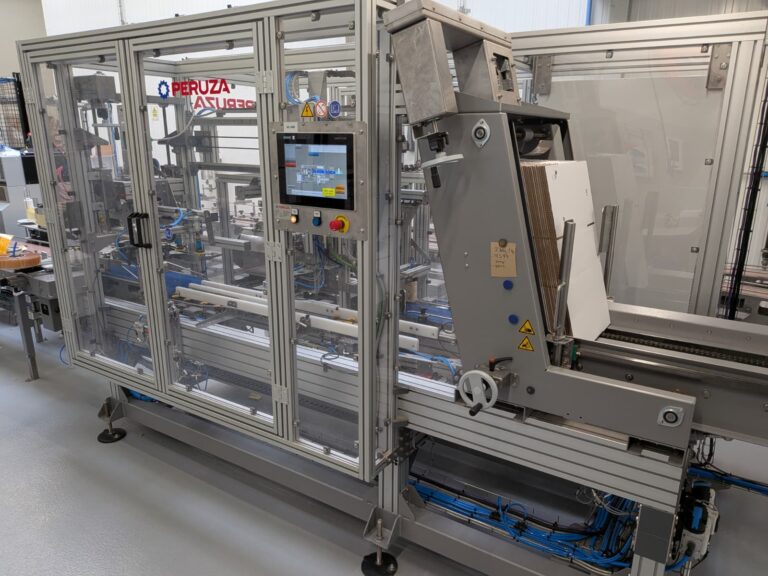
- PERUZA example: the PERUZA Side Loader erects, loads and seals the case in one machine, at up to 40 products per minute.
Why fragile products need a different case packer
On most food lines, the case packer is where product that survived filling, capping and labelling gets damaged. Glass jars crack, labels scuff, foil lids lift and soft packs deform. Each damaged unit means rework, a stopped line for cleanup, or a retail rejection.
The usual response is to slow the line down. A better response is to change how the product enters the case. That is what a side loader does.
Where top-load and drop packing struggle
Top-load case packers are fast and work well for rigid, uniform products such as cans. They place product into the case from above, either by dropping it through guides or by lowering it with a pick-and-place head. Problems appear when the product is fragile or awkward to grip from the top:
- Impact damage. In drop packing, glass containers land on each other or on the case bottom. This causes chipping, hairline cracks and, in the worst case, breakage that stops the line for cleanup.
- Difficult top geometry. Foil-sealed lids, tapered containers, decorative caps and flexible pouches give a suction cup or gripper little to hold safely. Some can be top-picked with custom tooling, but at higher cost and risk.
- Label and seal damage. Tight drop guides and fast transfers rub labels and stress seals.
- Mispacks. A small misalignment during a fast drop leaves a case short, tipped or torn.
Not all damage comes from the case packer. Line pressure on accumulation conveyors is a common cause of label scuffing, so upstream conveying should be checked at the same time.
How a side loader protects the product
A side loader keeps the product upright, supported and under control from infeed to sealed case. A typical cycle runs like this:
- Infeed and lane division. Products arrive on the conveyor and are divided into lanes with minimal back pressure.
- Collation. The machine groups products into the pack pattern, for example 2×3 or 3×4.
- Case erecting. A flat blank is opened into a case lying on its side, with one end open.
- Horizontal loading. A servo-driven pusher slides the whole group across a dead plate into the case.
- Closing and sealing. The flaps are folded and glued or taped, and the case leaves for palletizing.
Three design principles make this gentle:
- Controlled acceleration. Servo drives follow programmed motion profiles instead of abrupt pneumatic strokes. This limits jar-to-jar impact and liquid slosh.
- Positive support. The product slides; it never falls. That removes impact cracking and tipped containers.
- Contact on the side, not the top. Lids, seals and caps are never touched or loaded, which matters for foil-sealed packs and narrow necks.
In PERUZA’s own installations this includes side-loading packs of roe, a product where seal integrity and upright orientation both matter.
Top-load vs. side-load: what changes
Side loading trades some peak speed for control. The table compares typical behaviour; exact figures depend on product, pack pattern and machine design.
| Factor | Top-load / drop packing | Side-load case packing |
|---|---|---|
| How product enters the case | Dropped or lowered from above | Pushed horizontally, fully supported |
| Typical speed | Higher; suits high-volume rigid products | Moderate; PERUZA Side Loader up to 40 products/min |
| Risk to glass and fragile packs | Higher, from impact and drop guides | Low, no free fall |
| Lids, caps and seals | Touched or loaded by grippers or guides | Not touched |
| Product orientation in case | Usually upright | Upright, or laid down if the pack requires |
| Case handling | Often a separate erector and sealer | Often erect, load and seal in one machine |
| Changeover | Tooling and guide changes | Recipe selection on the HMI plus format parts |
| Best fit | Cans, rigid bottles, sturdy cartons | Glass jars, narrow-neck bottles, aerosols, sealed trays and packs |
When a side loader is the right choice
Choose a side loader when product damage, not case rate, is what limits your line. It is usually the right fit when:
- your product is glass, has a narrow neck, or has a lid or seal that must not be touched;
- breakage or label damage at the case packer is a recurring cost or a customer complaint;
- products must stand upright in the case for retail-ready presentation;
- you want case erecting, loading and sealing in one compact machine.
A top-load or robotic pick-and-place packer may be the better fit when you pack rigid, uniform containers at very high rates, or when your product mix needs frequent changes of pack pattern that a robot handles more flexibly.
In food plants, also check the basics: food-contact and splash-zone materials, washdown rating for wet areas such as seafood processing, guarding and CE conformity, and access for cleaning and format change.
Fitting a side loader into your end of line
A side loader protects the product only if the equipment around it does too. Plan it together with the conveyors that feed it and the palletizer that follows it, so cases arrive at a steady rate and are stacked without crushing.
Questions to answer before you request a quote:
- What is your required rate, in products and cases per minute, including future growth?
- Which products, containers and pack patterns must the machine handle, and how often do you change over?
- Where does damage happen today: upstream conveying, the case packer, or palletizing?
- What floor space and line layout do you have?
- Which hygiene and washdown conditions apply in that area?
Frequently asked questions
What is a side loader in packaging? A side loader, or side-load case packer, groups products and pushes them horizontally into a case lying on its side, then closes and seals the case.
What is the difference between top-load and side-load case packing? Top-load packers drop or lower products into the case from above and are usually faster. Side-load packers slide products in from the side, which is gentler and avoids touching lids or caps.
Which products should be side loaded? Glass jars, narrow-neck bottles, aerosol cans, foil-sealed trays and other fragile or top-sensitive packs, plus any product that must stand upright on the shelf.
Are side loaders slower than top loaders? Usually, yes. They are chosen where lower damage and better presentation outweigh peak speed. The PERUZA Side Loader handles up to 40 products per minute.
Can a side loader also erect and seal cases? Many can. The PERUZA Side Loader covers the whole process, from forming the case to sealing it.
Will a side loader eliminate all product damage? No machine guarantees zero damage. A side loader removes drop and impact damage at the packing step, but upstream conveying and palletizing must also be set up correctly.
Is the case packer where your product gets damaged?
PERUZA is a Latvian process engineering and equipment manufacturer with more than 30 years of experience in food processing automation, especially fish and seafood. We design side loaders, case packers and palletizers around your product and line. Contact us to review where damage happens on your line and whether side loading is the right fix