Can packaging and palletizing be automated inside a freezer?
Yes. Case packing and palletizing can run reliably at -18°C to -30°C, but only if the equipment is specified for the cold from the start. Standard machines usually fail on four things: the wrong belt plastic, lubricants that thicken, moisture that freezes in compressed air and sensors, and cables that crack when they flex. Get those right, and automation reduces cold exposure for staff and removes warm-zone handling steps from the frozen product’s journey.
In short:
- Belts: polypropylene modular belts are typically rated only down to about +5°C. Freezer conveyors use polyethylene (to about -70°C) or acetal (to about -40°C).
- Compressed air: the pressure dew point must be below the coldest room temperature. That usually means a desiccant dryer, not a refrigerated one.
- Heat load: every kilowatt of motor and heater power inside the freezer has to be removed again by the refrigeration plant.
- The decision: packing inside the freezer is not always best. Many plants pack in a chilled room next to the freezer and move pallets into cold store within minutes.
Where does cold-room automation sit in a frozen food line?
Most frozen food and seafood lines follow the same end-of-line sequence. What changes is the temperature zone where each step happens.
- Freezing. Product is frozen in a plate freezer (blocks or cartons), a blast freezer, or a spiral or tunnel freezer (IQF).
- Packing. Frozen blocks, bags or trays are packed into master cartons. This is often done in a chilled packing room at about 0 to +10°C, right next to the freezer.
- Palletizing. Cartons are stacked and stabilized. This happens either in the packing room or in a cold anteroom.
- Cold storage. Pallets go into the cold store, typically at -25°C or colder.
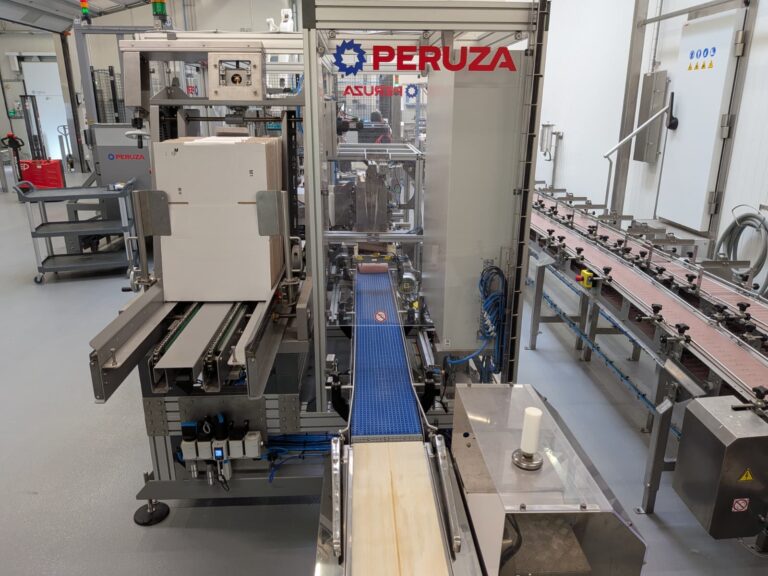
“Sub-zero automation” means moving steps 2 and 3, or only step 3, into the frozen zone. It can also mean automating the transfer between zones so product spends less time in the warm.
What goes wrong with standard equipment below -18°C?
Most failures come from a few predictable causes. Each one has a known engineering fix.
Challenge | What happens in the cold | Engineering fix |
|---|---|---|
Belt material | Polypropylene modules turn brittle and crack under impact | Polyethylene or acetal modular belts, nylon or acetal hinge rods |
Lubrication | Standard oils and greases thicken, raising drive torque and bearing wear | Low-temperature synthetic gear oils and greases rated for the room temperature |
Thermal contraction | Mixed-metal assemblies shrink by different amounts, loading joints and misaligning shafts | Slotted fixings and expansion allowances, matched materials, alignment checked at operating temperature |
Compressed air | Water in the air freezes in valves and cylinders | Desiccant dryer with a pressure dew point below the coldest room temperature, or servo-electric axes |
Sensors and vision | Frost and condensation blind optics, mainly at doors and during defrost | Heated sensor housings, placement away from door air streams, sensors rated for the temperature |
Cables | Standard PVC-jacketed cables stiffen and crack when they flex | Cold-rated PUR cables in drag chains |
Electronics and HMIs | Displays slow down; condensation forms when cabinets warm up | Heated, insulated control cabinets, or cabinets placed outside the freezer |
Vacuum grippers | Frost and coated cartons make suction cups leak | Low-temperature cup materials such as silicone, vacuum monitoring per zone |
What are the benefits of automating in the cold?
The main benefits are fewer people working in sub-zero conditions, fewer temperature swings for the product, and steadier output across shifts.
Less cold exposure for staff
Work in freezers is physically demanding. Cold-stress guidance, such as ISO 11079, and national rules call for protective clothing and work–warm-up cycles. That cuts productive hours per shift and makes cold-room roles hard to staff. Automating repetitive packing and stacking lets operators supervise from a heated control area. Maintenance work in the freezer remains.
Fewer temperature swings for the product
In the EU, quick-frozen food must be kept at -18°C or lower at all points in the product. Only brief upward fluctuations of no more than 3°C are allowed during transport (Directive 89/108/EEC).
Each handling step in a warmer zone adds a small temperature cycle, starting at the product’s surface. Repeated cycling causes ice recrystallization, freezer burn and drip loss on thawing. Small IQF items, such as shrimp or berries, warm fastest because of their low mass. Large frozen blocks are more forgiving. Keeping packing and palletizing cold, or simply shortening the time between freezer and cold store, limits these swings.
Steadier output
Machines do not need warm-up breaks, so output stays consistent across a shift. Plan for scheduled stops all the same: defrost of the freezer and evaporators, cleaning, and preventive maintenance.
More consistent pallets
Robotic palletizing repeats the same stacking pattern every time. Combined with correct layer patterns, layer pads and stretch-wrapping, this reduces leaning and collapsed loads in the cold store.
How PERUZA approaches frozen food end-of-line automation
PERUZA is a Latvian process engineering and equipment manufacturer with more than 30 years of experience in food processing automation, especially for fish and seafood. We design end-of-line systems around the product, the line and the temperature zones it runs through.
Solution | What it does | Where it fits in a frozen line |
|---|---|---|
Contact freezing of products in boxes, trays or cartons, with automatic loading and unloading; up to 7 t/h | Freezing step; feeds frozen blocks or cartons straight to packing | |
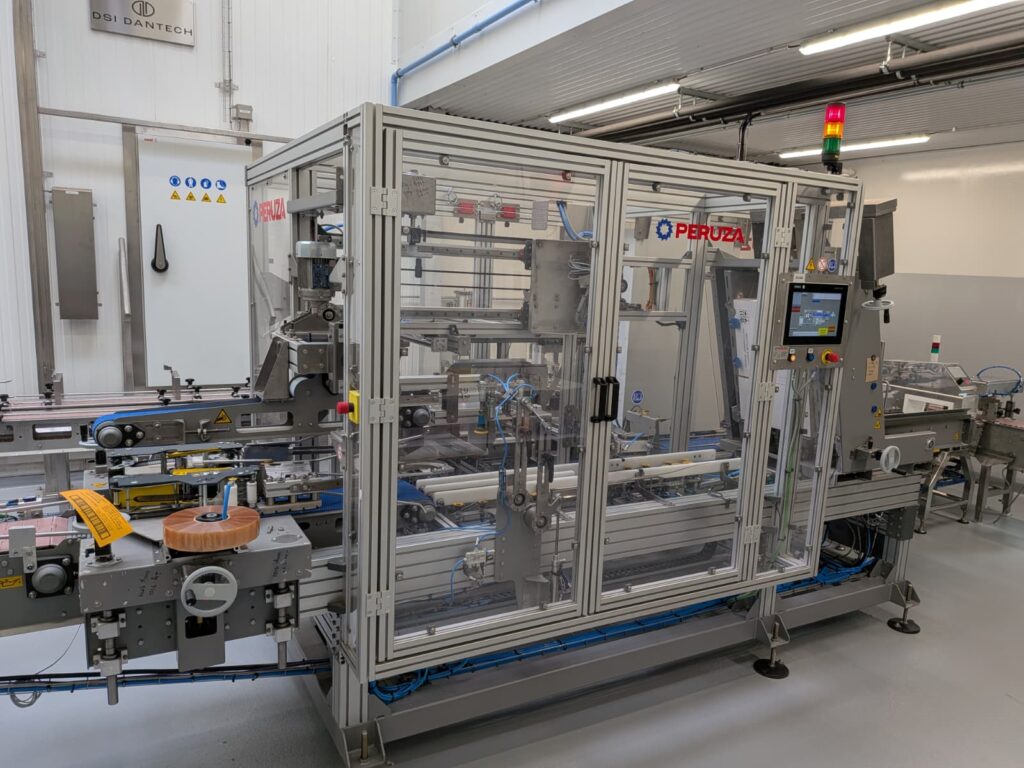
Erects, loads and seals the case in one machine; pushes product in horizontally; up to 40 products per minute | Packing of sealed trays and packs where lids and seals must not be touched | |
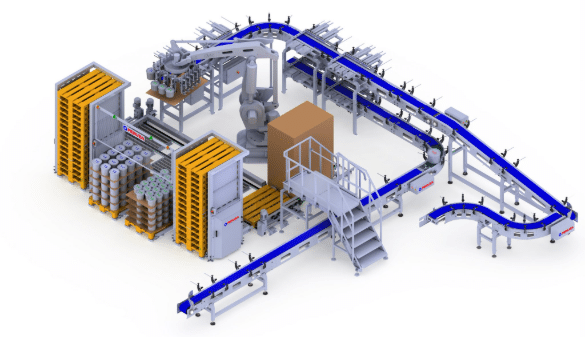
Palletizes onto up to three pallets at once, with layer-pad insertion and pallet conveyors; up to 20 units per minute | End of line, before the cold store | |
Forms and places complete layers | High-volume, uniform cartons |
Conclusion: specify for the cold from day one
Sub-zero packing and palletizing works when temperature is part of the specification, not an afterthought. That means the right belt resin, low-temperature lubricants, dry compressed air, protected sensors and cables, a refrigeration plant sized for the added heat, and a layout that technicians can service.
Done well, it reduces cold-room labour, limits temperature swings for the product, and keeps pallets consistent. For some plants, a fast, well-organised chilled packing room is the better answer, and the business case should decide.
Planning frozen food or seafood end-of-line automation? Contact PERUZA to review your line, temperature zones and capacity targets.