Not every product on a packing line can survive a drop, a knock, or a quick push into the corner of a box. Eggs, glass jars, delicate bakery items, aerosol cans- these products punish careless equipment immediately, and the damage is expensive: broken goods, rejected pallets, and unhappy retail partners. When you are choosing a case packer for this kind of product, “fast” is not the first question to ask. “Gentle” is.
Below are the things worth looking into before you commit to a machine, along with a real example that shows why they matter.
Start with how the product is actually touched
Every case packer moves a product from a conveyor into a box, but the path it takes to get there is not the same across machines. Standard case packers typically drop or push products into an open case. That works well for cans, cartons, or rigid packs, but for anything fragile, that final drop — even a short one — is where cracks and dents happen.
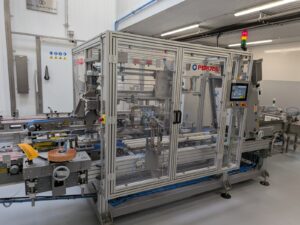
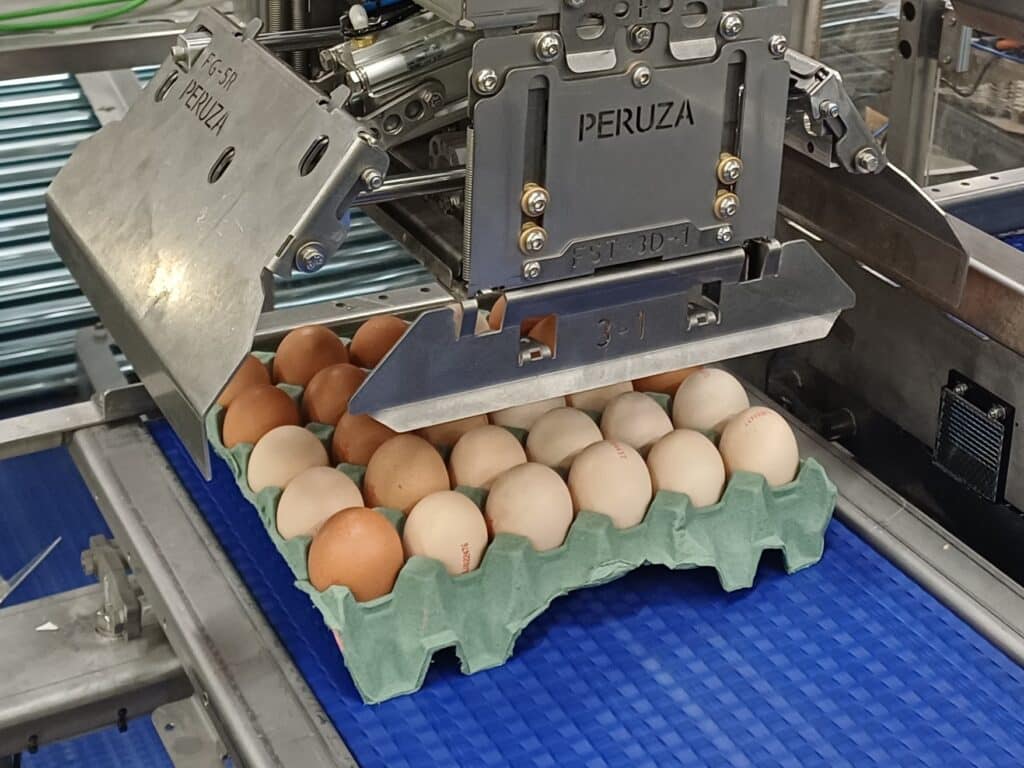
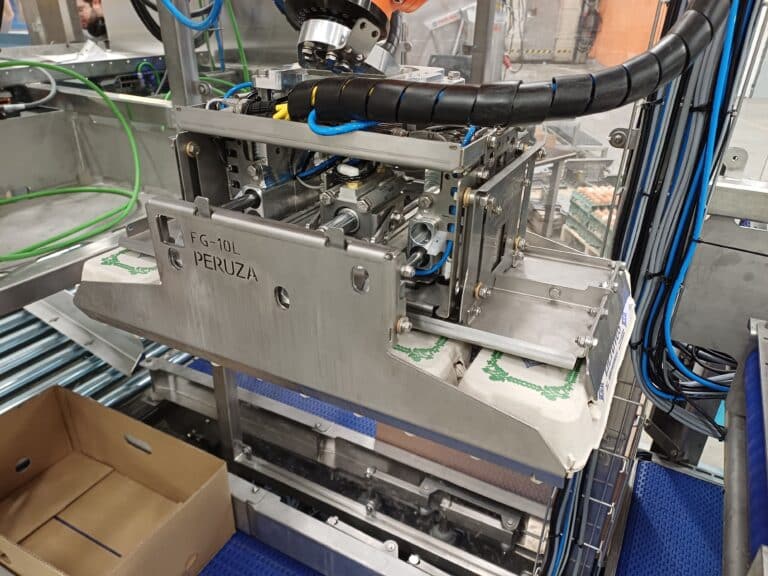
PERUZA Egg Case Packer approaches the box with specially product-designed gripper, guiding the product in the box smoothly rather than letting gravity do the work. There is no drop, no impact against the base of the case. For fragile eggs these factors are game changing.
Check how it handles a product that is never quite the same twice
Fragile products are rarely perfectly uniform. Eggs are a good example: size, shape, and shell strength vary from one to the next, even within the same batch. A case packer built around rigid, identical-product assumptions will struggle here — and every mismatch is a potential breakage.
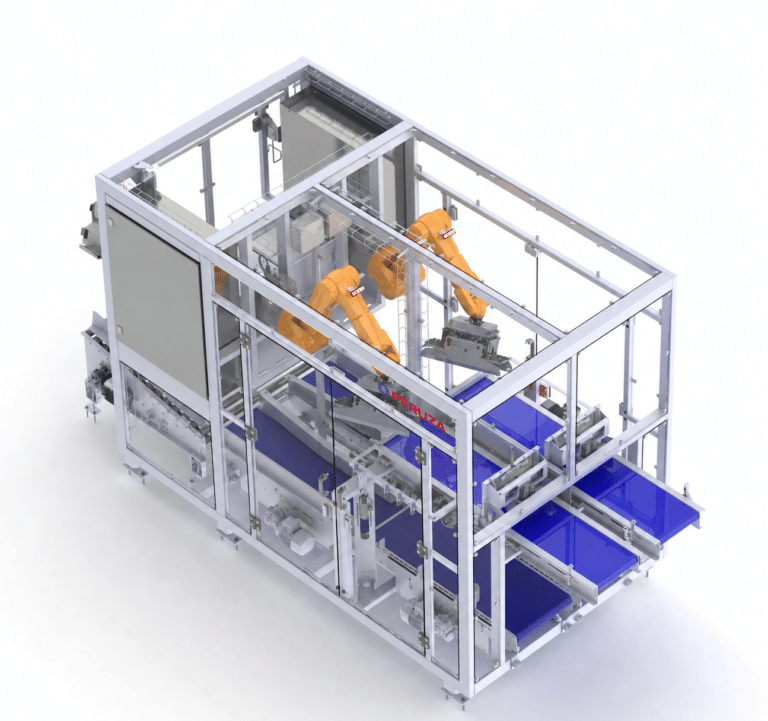
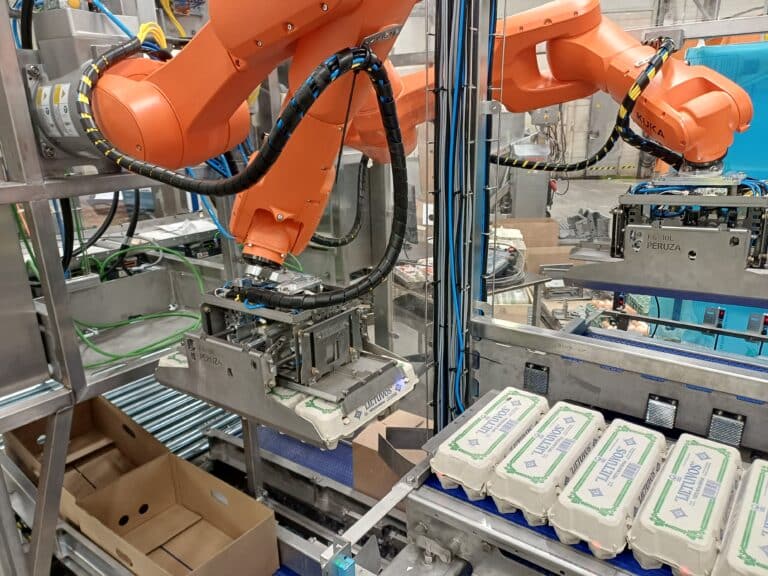
This is exactly what makes the PERUZA Egg Case Packer worth watching in action. Its double packing station uses two robotic arms working two independent packing lines, so it can place a naturally inconsistent, fragile product into cases with controlled, repeatable movement, rather than forcing every unit through the same rigid motion. Each robot’s gripper is built from a fixed head plus a swappable middle section and paddles, so the exact touchpoint on the product can be matched to the pack format instead of being a one-size-fits-all clamp.
Keep that in mind as a benchmark while you evaluate other machines. If a supplier’s equipment can’t demonstrate similarly controlled handling on your own product, that’s a conversation worth having before you sign anything.
Don't treat speed and gentleness as opposites
It’s tempting to assume that protecting a fragile product means slowing everything down. That’s not necessarily true — it depends on the engineering. A well-designed case packer for fragile goods reaches high throughput specifically because it avoids drops, sudden stops, and rough transitions, not despite avoiding them. Smooth, controlled motion tends to be fast motion, since the machine isn’t fighting against impact and misalignment caused by rough handling.
Real installations back this up: a twin-robot egg case packer, run with two independent channels, can move well beyond 60,000 eggs per hour on some pack formats — output that’s only possible because the handling stays gentle and consistent cycle after cycle. When comparing machines, ask for:
- Real cycle times from existing installations, not just theoretical top speeds
- Product-loss or breakage figures from those same installations
- Data specifically on a product comparable to yours, not a generic benchmark
- References or site visits where you can see the machine running that product
Look at what the machine does beyond just placing the product
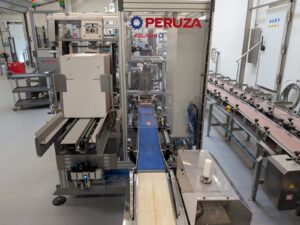
Placing the product into the case is only part of the job. Many modern case packer lines pair the packer with an automatic box erector and sealer upstream, so cases arrive pre-formed, squared, and taped before the product ever reaches them. For fragile product lines, this matters even more, because every extra manual step — someone folding a flap, someone re-positioning a jar that landed off-center — introduces another chance for damage or a slowdown. A box-forming, product-placement, and sealing sequence that runs as one continuous, automated flow removes those weak points, including built-in checks that confirm a case is square before it’s sealed.
Ask about changeovers and product variety
Few facilities run a single product, size, or box format forever. If your line handles different pack configurations, different case sizes, or seasonal packaging changes, find out how quickly the case packer can switch between them. Look for features like quick size changeover and swappable gripper components — these turn a format change into a short adjustment rather than hours of manual reconfiguration, which eats into the very efficiency the machine was supposed to deliver, and repeated manual adjustment around fragile product handling is itself a risk.
Consider integration with what's already on your line
A case packer rarely works alone. For products like eggs, it typically needs to sit downstream of a grading or sorting system, feeding boxed or pre-formed cases from a folder/sealer on one end and coordinating with product infeed and full-case takeaway conveyors on the other. Before choosing equipment, look into how easily it communicates with your existing upstream and downstream machinery, and whether the manufacturer has experience connecting to the specific systems you already run. Compatibility issues discovered after installation are far costlier to fix than issues caught during planning.
Factor in hygiene, footprint, and support
For food-grade fragile products in particular, look into how easily the machine can be cleaned and how it fits your sanitation routine. Equipment built with an external stainless-steel finish (AISI 304) and designed for wet-environment operation is easier to keep hygienic over years of daily washdown. Also check the physical footprint against your available floor space — compact, well-thought-out designs can make a real difference in smaller facilities. Finally, ask about service and support: installation timelines, on-site commissioning, training, and warranty terms. Fragile-product lines have less tolerance for downtime, since a stalled machine often means a backlog of product with a short shelf life or handling window.
Bringing it together
Choosing a case packer for fragile products comes down to one central question: does this machine protect the product while it works, not just when everything goes perfectly? When you weigh your options, it comes down to:
- Whether it handles natural product variation with controlled, repeatable motion
- Whether speed comes from smooth handling rather than at the expense of it
- How well box handling, changeovers, and hygiene are integrated around the core job
- Whether the manufacturer can back it up with real support and service