
In this blog post you will learn why secondary case packing matters, what makes cheese and dairy products difficult to pack automatically, and how PERUZA builds complete end-of-line systems that solve these challenges.
Why Secondary Case Packing Matters
The Challenges of Case Packing Cheese and Food Products
- Multiple product sizes and case configurations.
- High production speeds with limited labour availability.
- The need for gentle handling to prevent package damage.
- Strict hygiene and food safety requirements.
- Frequent product changeovers.
Manual packing processes can struggle to meet these requirements consistently, especially as production volumes continue to increase.
Automated Case Packers for Food and Beverage Production
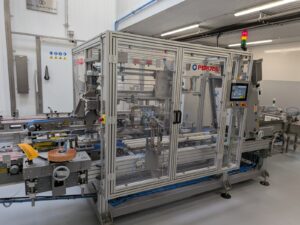
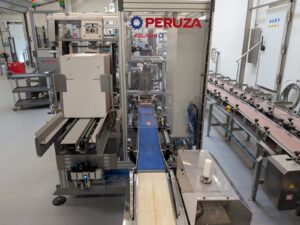
A robotic case packer automates the process of grouping products and placing them into shipping cases with high precision and repeatability.
Depending on the production requirements, products can be picked individually or in groups before being arranged into the required case pattern. Automated systems ensure accurate placement while maintaining product orientation and packaging quality.
Compared to manual packing, automated case packing provides several important advantages:
- Increased production capacity.
- Consistent packing quality.
- Reduced labour dependency.
- Improved operator safety.
- Lower risk of product and packaging damage.
These benefits make automation an increasingly valuable investment for food and beverage producers looking to improve efficiency without compromising product quality.
Choosing the Right Case Packing Solution
Not every product requires the same type of case packer. The optimal solution depends on several factors, including product shape, packaging material, production speed, and available factory space.
For example, cheese products packaged in trays or thermoformed packs may require gentle robotic handling, while beverage multipacks or cartons can benefit from high-speed packing systems designed for larger production volumes.
Selecting the right secondary case packing solution helps manufacturers achieve reliable production while maintaining flexibility for future product changes.

Integrating Case Packing into End-of-Line Automation
Modern packaging lines achieve the greatest efficiency when individual machines operate as one complete system.
An automated case packer can be integrated with equipment such as:
- Product conveying systems
- Case erectors
- Case sealing machines
- Labelling systems
- Robotic palletizers
- Stretch wrapping equipment
By connecting these processes, manufacturers create a fully automated end-of-line solution that minimizes manual intervention and improves overall equipment effectiveness.
Top Load, Wrap-Around, or Side Load: Which Case Packer Fits Cheese?
Case packers generally fall into three families, and each handles cheese products differently.
Top load case packers drop or place product into a pre-formed case from above. They’re fast and well suited to sturdy, uniformly shaped products, but a top-down motion can be harsher on delicate blocks or soft-format cheese.
Wrap-around case packers form and seal a carton blank directly around the product, rather than dropping the product into an existing case. This is the approach PERUZA uses for cheese blocks: the carton is formed and closed with hot glue around the block itself, so the product is supported throughout the cycle instead of being dropped into place. It’s a natural fit for a single, consistently shaped product like a cheese block moving at high speed.
Side load case packers insert product into the case from the side, which is the gentlest option for fragile or awkwardly shaped items such as jars, narrow-necked containers, or delicate multipacks — though it isn’t usually necessary for a solid product like a cheese block.
For most cheese and dairy lines, the deciding factors are product shape, required speed, and how much protection the product needs during the packing motion.
Preparing Food and Beverage Production for Future Growth
As production volumes continue to increase and labour becomes more difficult to source, investing in automation is becoming a strategic necessity.
Automated secondary case packaging, improves efficiency, reduces operating costs and helps manufacturers maintain consistent packaging quality across different product formats.
Whether packaging cheese, dairy products, beverages, or other food products, the right case packer can streamline end-of-line operations while creating a scalable packaging process ready for future growth.
Choosing the right case packer depends on your product, your speed requirements, and how your line is laid out- every production floor is different.
Our team can walk through your specific needs and recommend the right case packing setup for your line. Contact PERUZA to explore the right case packing and see already made solutions for your business.